No subcategories available.
View ProductsShop our wide range of fasteners
View range
No subcategories available.
View Products
Have a DIY question? Chances are we’ve answered it here. If not, we’re just a message away.
A pilot hole is recommended when using self-tapping screws. If you are getting self-tapping screws confused with self-drilling screws, they aren't the same.
Self-tapping screws can tap threads into the material, be it wood, metal and brick. It is important to drill a pilot hole before install, particularly if you’re using metal, as it reduces stress on your tools and prevents the material from cracking or splitting during insertion. A pilot hole will make insertion easier, cleaner and more accurate.
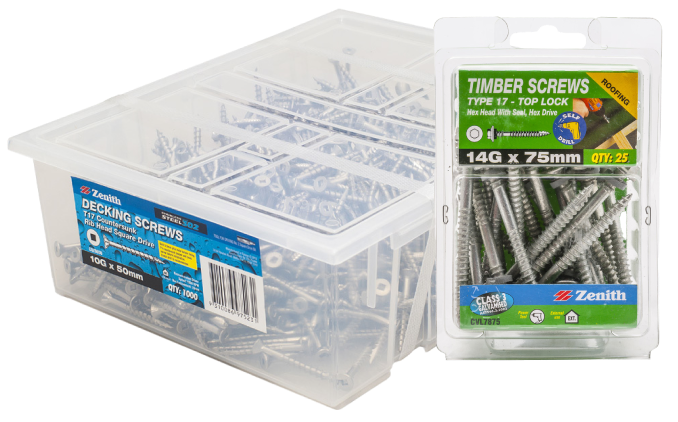
While some roofing screws can be used for both metal and timber battens, you'll get better results from using fasteners designed for the specific material. For timber battens, Zenith® Type 17 Galvanised with Seal Timber Screws (hexagonal heads) are purpose-built for roofing applications. Those with a Top Lock are primarily for crest fixing to reduce indentation during installation.
If you’re working in marine environments or anywhere that copes high moisture and needs high corrosion resistance, go stainless steel. Zenith® 304 Stainless Steel Self Tapping Screws are built for external household construction and outdoor furniture where stronger corrosion protection is needed.
Zenith® Hexagonal Head Gold Passivated Metal Screws are made for exactly this. They are for general-purpose fixing of timber and metal components onto metal surfaces. Simply screw directly through the timber batten into the steel frame using a hex driver bit - no pre-drilling required.
No, Keep them inside where they belong. Moisture and varying weather conditions demand a more durable screw for external use. Wood screws, like the Zenith® Assorted Zinc Plated Steel Wood Screws, are ideal for general-purpose indoor applications, including woodwork, furniture, and cabinetry.
Zenith® Gold Passivated Bugle Batten Screws are suitable for internal heavy-duty applications across different timbers. The Bugle Head sits flush, while the gold passivated steel finish handles moderate corrosion resistance. Both are solid performers for indoors.
Yes, Stainless 316 marine-grade is strongly recommended in coastal areas and severe corrosive environments to ensure long-lasting results. Unlike galvanised screws, which can eventually rust once their protective coating wears away. Stainless steel provides long-term durability.
Zenith® Wall Plugs are your go-to for light-duty fastening tasks in brick or masonry walls. The anchors expand inside the drilled hole, creating a secure fixing point in solid masonry materials. Easy, reliable and it won’t let your picture end up on the floor.
TPI stands for threads per inch and determines how fine or coarse a screw’s thread pattern is. A higher TPI means better holding power in thin materials (such as metal panels 1-2mm thick) and less likely to tear the surface of the material. A lower TPI creates faster insertion and is ideal for softer materials like wood.
For a long-lasting, flush finish on hardwood and softwood timber deck boards reach for Zenith® Type 17 304 Stainless Steel Decking Screws. Corrosion-resistant and durable, the screws are designed specifically for decking applications.
Zenith® QUICKSHOT™ Drill Point 304 Stainless Steel Decking Screws are the better pick for general fixing into treated pine or soft timber where strong and lasting corrosion protection is required. The countersunk ribbed head creates a flush finish for all outdoor projects.
Do it in three easy steps:
1. Position the Zenith® Scotch Tee Hinge in situ on the gate and check that there’s adequate space for correct installation.
2. Fasten hinges to the gate with screws provided using a No. 2 Phillips bit at 1,000 RPM.
3. Check that the new hinge is secure without being fastened too tightly. You want it snug, not stripped. And there you have it – simple as!
Bolts are a specific type of fastener. While we do separate bolts from other fasteners like screws, bolts rely on a nut for fastening. Types of bolts in the Zenith range include hex (hexagonal) head bolts, which are suited for heavy-duty applications. We also supply cup head bolts for a flush finish and are suited to timber applications. Each one does a different job, so it helps to know the difference.
Yes, nails are considered fasteners, but it is important to distinguish key differences between nails and screws. Nails have more elasticity than screws and are typically turned to as a low-cost option for construction projects. Our range of timber screws, plasterboard screws, metal screws and roof and cladding fasteners offer superior tensile strength for a better hold that lasts longer too.
We have a range of screws specially crafted to withstand Australia’s harsh weather conditions. Our stainless-steel deck screws are suitable for everyday outdoor timber applications, with the Stainless Steel 304 coating designed to resist rust and corrosion. Zenith Timber screws are available in Stainless steel, Class 3 galvanized and treated pine safe finishes.